Is the licensing of builders on the way in the UK?
In our latest LMC Meets interview, we talk to the FMB about its proposals for builder licensing to raise standards and improve consumer protection.
By Liz Male
11 Aug 2026
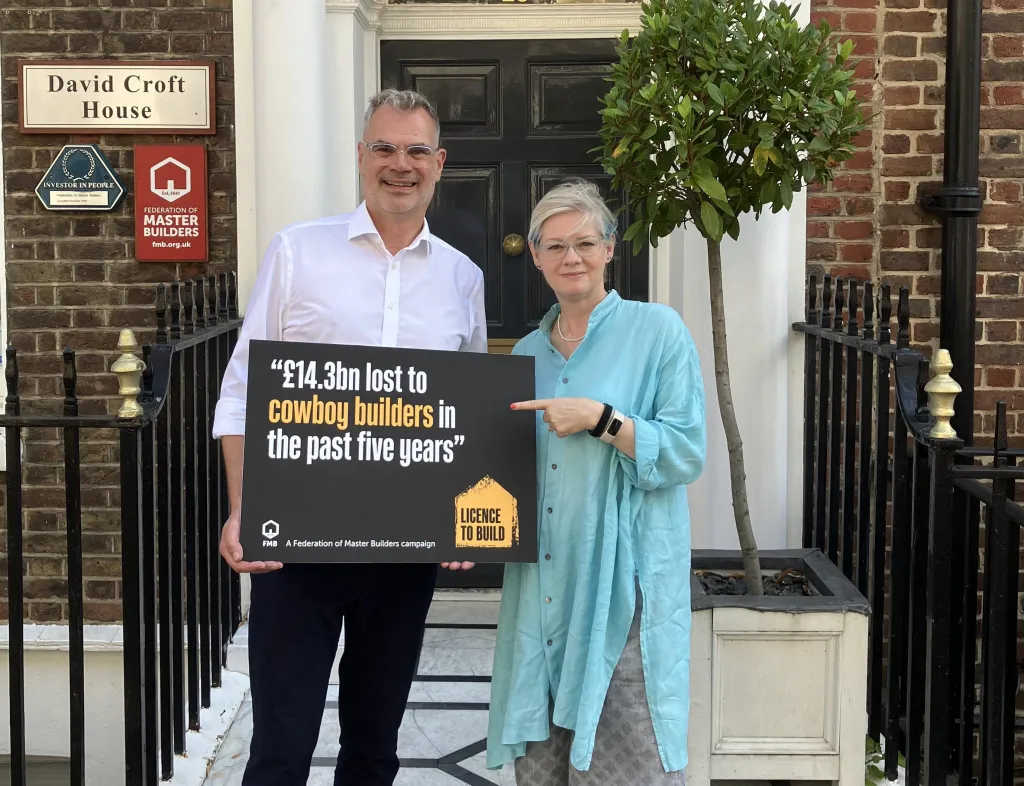
In our latest LMC Meets interview, Liz Male speaks to Brian Berry, chief executive of the Federation of Master Builders (FMB), about its proposals to introduce mandatory licensing for UK building firms.
For years, the FMB has campaigned for a mandatory licensing scheme to improve standards, protect consumers and raise the reputation of professional builders.
Against the backdrop of the Building Safety Act, competence reform and the proposed Single Construction Regulator, the conversation explores why the debate has never been more relevant.
For years, the FMB has campaigned for a mandatory licensing scheme to improve standards, protect consumers and raise the reputation of professional builders.
Against the backdrop of the Building Safety Act, competence reform and the proposed Single Construction Regulator, the conversation explores why the debate has never been more relevant.
Rogue traders - understanding the scale of the issue
How serious is the problem of rogue traders - so called 'cowboy builders' - in the UK's home improvement market?
Understanding the scale of what consumer protection experts tend to refer to as 'consumer detriment' got me a bit tangled up in the numbers, but let me unpack it all here.
The FMB and the HomeOwners Alliance published research just over a year ago which suggested that over a third of adults in Britain had hired a builder who turned out to be unreliable or unqualified, with homeowners losing £14.3bn to cowboy builders since 2020.
As you'll see in the video, I initially thought that was £14.3bn a year - thank goodness I got that wrong. But the figure is still staggeringly large - it's based on 15% of UK adults reporting a financial loss to a rogue builder between 2020-25, with an average loss of £1,759 per affected person. Effectively, £2.86bn a year spent on shoddy work by ordinary consumers - double the Government's annual budget for rebuilding crumbling classrooms and repairing school buildings in England.
The RMI (repair, maintenance and improvement) market used to be valued at around £27bn per year (that was the number I remembered from 'Construction 2025', the industrial strategy report published in 2013, when the cost of complaints was estimated at £1.5bn a year). More recently, I've seen figures to suggest that the RMI market is much, much larger - more than £60bn a year.
This is a massive investment in existing private housing which brings economic security to builders and other tradespeople, as well as all those who advise them, and supply them with materials and services. It's too important a market to ignore.
So tackling the financial impact of incompetence, poor workmanship and downright fraud in this sector is critical. Even before you think of the hundreds of thousands of homeowners left with dangerous work and damaged homes, the families tipped into debt and lengthy disputes, and the huge toll that takes on anyone's wellbeing, physical and mental health.
As the FMB puts it, the problem "puts lives at risk, damages trust, and undermines the reputation of every honest professional delivering high-quality work."
Understanding the scale of what consumer protection experts tend to refer to as 'consumer detriment' got me a bit tangled up in the numbers, but let me unpack it all here.
The FMB and the HomeOwners Alliance published research just over a year ago which suggested that over a third of adults in Britain had hired a builder who turned out to be unreliable or unqualified, with homeowners losing £14.3bn to cowboy builders since 2020.
As you'll see in the video, I initially thought that was £14.3bn a year - thank goodness I got that wrong. But the figure is still staggeringly large - it's based on 15% of UK adults reporting a financial loss to a rogue builder between 2020-25, with an average loss of £1,759 per affected person. Effectively, £2.86bn a year spent on shoddy work by ordinary consumers - double the Government's annual budget for rebuilding crumbling classrooms and repairing school buildings in England.
The RMI (repair, maintenance and improvement) market used to be valued at around £27bn per year (that was the number I remembered from 'Construction 2025', the industrial strategy report published in 2013, when the cost of complaints was estimated at £1.5bn a year). More recently, I've seen figures to suggest that the RMI market is much, much larger - more than £60bn a year.
This is a massive investment in existing private housing which brings economic security to builders and other tradespeople, as well as all those who advise them, and supply them with materials and services. It's too important a market to ignore.
So tackling the financial impact of incompetence, poor workmanship and downright fraud in this sector is critical. Even before you think of the hundreds of thousands of homeowners left with dangerous work and damaged homes, the families tipped into debt and lengthy disputes, and the huge toll that takes on anyone's wellbeing, physical and mental health.
As the FMB puts it, the problem "puts lives at risk, damages trust, and undermines the reputation of every honest professional delivering high-quality work."
The Government's approach to consumer protection in the RMI sector
In the UK, various Government departments have stepped in over the years to try and tackle this problem.
After a disastrous 'Quality Mark' scheme set up by the then Department for Trade and Industry (DTI) in 2000, which attempted to establish a centralised register of quality builders and closed after its regional pilots only managed to recruit about 350 firms, construction minister Alun Michael launched TrustMark in 2005. [Full disclosure: We were the PR agency that helped to launch that scheme, and I personally went on to become chair of TrustMark from 2010-17].
TrustMark operated under licence from the DTI. But there were also other schemes sponsored by other departments: Defra had a WaterSafe scheme for plumbers. MHCLG had its Competent Persons Register for firms that could self-certify their work under the building regulations. The HSE (overseen by the Department for Work and Pensions) had the Gas Safe Register. The Department of Energy and Climate Change had the MCS scheme and 'Green Deal Approved' register. The OFT had a Trading Standards approved code scheme for local trades...
And this is where history seems to be repeating itself, with now another consultation coming out of DESNZ this summer proposing its own new consumer protection scheme to cover retrofit installations in the Warm Homes Plan.
Brian Berry and I discussed this in our interview. And I think it's fair to say that we both believe that, if we are really going to make a difference to consumer protection and the signposting to reputable firms in the RMI / home improvement / retrofit sector, then a bit more joined-upness within Government itself would be a damn fine place to start.
After a disastrous 'Quality Mark' scheme set up by the then Department for Trade and Industry (DTI) in 2000, which attempted to establish a centralised register of quality builders and closed after its regional pilots only managed to recruit about 350 firms, construction minister Alun Michael launched TrustMark in 2005. [Full disclosure: We were the PR agency that helped to launch that scheme, and I personally went on to become chair of TrustMark from 2010-17].
TrustMark operated under licence from the DTI. But there were also other schemes sponsored by other departments: Defra had a WaterSafe scheme for plumbers. MHCLG had its Competent Persons Register for firms that could self-certify their work under the building regulations. The HSE (overseen by the Department for Work and Pensions) had the Gas Safe Register. The Department of Energy and Climate Change had the MCS scheme and 'Green Deal Approved' register. The OFT had a Trading Standards approved code scheme for local trades...
And this is where history seems to be repeating itself, with now another consultation coming out of DESNZ this summer proposing its own new consumer protection scheme to cover retrofit installations in the Warm Homes Plan.
Brian Berry and I discussed this in our interview. And I think it's fair to say that we both believe that, if we are really going to make a difference to consumer protection and the signposting to reputable firms in the RMI / home improvement / retrofit sector, then a bit more joined-upness within Government itself would be a damn fine place to start.
Pushing at an open door?
Which brings us on to the current proposal for formal, legal licensing of building firms (and arguably, all trades).
Interestingly, the FMB research last year seems to show that many of the public think this already exists:
Interestingly, the FMB research last year seems to show that many of the public think this already exists:
- Two thirds (65%) of UK homeowners believe builders are required to have insurance to cover any compensation or damage caused by their actions.
- Two in five British homeowners (39%) think builders need to have passed tests to show they are competent.
- 45% of UK adults wrongly believe that builders are licensed.
- More than a third of UK homeowners (35%) believe builders must be registered with a professional organisation like the FMB to show a commitment to quality standards and ethical practices.
- And roughly a third of UK homeowners (32%) expect that builders must register with a government or regulatory body to trade.
There is, of course, currently a major focus on the creation of a Single Construction Regulator, potentially launching in 2028. And the Government's additional call for evidence on a strategy for built environment professions, trades and occupations closes this week.
The FMB sees its proposal for a licensing scheme directly linking in to such policy considerations, so maybe we are closer than we have ever been to seeing such regulation being introduced.
The FMB sees its proposal for a licensing scheme directly linking in to such policy considerations, so maybe we are closer than we have ever been to seeing such regulation being introduced.
The proposed model for improving standards
The FMB’s proposed model would create an independent licensing authority linked to government. Existing organisations, including trade bodies and approved scheme operators, could deliver the licensing process provided they met common national criteria.
Brian Berry suggests that licensing should begin at company level, including sole traders, rather than attempting immediately to assess every individual worker. Entry requirements could include an independent inspection of completed work, checks on insurance and court judgments, and evidence that the business is competently managed. Fees would operate on a sliding scale, with smaller firms paying less.
In many ways, it is identical to the TrustMark model. But unlike TrustMark and other voluntary arrangements, the licence would be mandatory for businesses carrying out defined building work.
Consumer redress would be central to the system. Again, just like TrustMark, complaints would first be raised with the builder, then escalated to the scheme operator and, where necessary, to the licensing authority and an ombudsman. It would feature insurance-backed protection for work and stronger measures against phoenix companies whose directors close one business and restart under another name.
Licensing, says Brian, would manage risk rather than guarantee that every project runs without difficulty. It's no surprise, given the age and variety of our housing stock, that building work often uncovers hidden defects and disputes can still arise.
However, a national framework would establish clearer standards, create a route for intervention and generate better data on recurring failures. That evidence could then inform training, inspection and future competence requirements.
Brian Berry suggests that licensing should begin at company level, including sole traders, rather than attempting immediately to assess every individual worker. Entry requirements could include an independent inspection of completed work, checks on insurance and court judgments, and evidence that the business is competently managed. Fees would operate on a sliding scale, with smaller firms paying less.
In many ways, it is identical to the TrustMark model. But unlike TrustMark and other voluntary arrangements, the licence would be mandatory for businesses carrying out defined building work.
Consumer redress would be central to the system. Again, just like TrustMark, complaints would first be raised with the builder, then escalated to the scheme operator and, where necessary, to the licensing authority and an ombudsman. It would feature insurance-backed protection for work and stronger measures against phoenix companies whose directors close one business and restart under another name.
Licensing, says Brian, would manage risk rather than guarantee that every project runs without difficulty. It's no surprise, given the age and variety of our housing stock, that building work often uncovers hidden defects and disputes can still arise.
However, a national framework would establish clearer standards, create a route for intervention and generate better data on recurring failures. That evidence could then inform training, inspection and future competence requirements.
The challenge is now political
The FMB has been garnering a lot of political support for its ideas.
The message to parliamentarians is that the case for licensing combines consumer protection, building safety, productivity and economic growth.
The challenge is now political. Government departments, regulators, lenders and industry bodies would need to align around one coherent system, supported by strong enforcement and a clear public information campaign. (Those last two things have been sorely missing for many years).
The FMB's core message is this: after decades of fragmented voluntary initiatives, the industry needs a single, credible framework that rewards competent builders and protects all consumers, particularly the most vulnerable, from a wide range of traders, from the unchecked chancers through to those with deliberate criminal intent.
The message to parliamentarians is that the case for licensing combines consumer protection, building safety, productivity and economic growth.
The challenge is now political. Government departments, regulators, lenders and industry bodies would need to align around one coherent system, supported by strong enforcement and a clear public information campaign. (Those last two things have been sorely missing for many years).
The FMB's core message is this: after decades of fragmented voluntary initiatives, the industry needs a single, credible framework that rewards competent builders and protects all consumers, particularly the most vulnerable, from a wide range of traders, from the unchecked chancers through to those with deliberate criminal intent.
Key features of the Licence to Build
- A mandatory licence for building firms, replacing the current reliance on voluntary membership and self-regulation.
- An independent licensing authority linked to government, responsible for setting national standards and overseeing the system.
- Delivery through approved scheme operators, such as trade bodies and other bodies that meet the authority’s criteria.
- Licensing at business level initially, covering companies and sole traders, with possible individual competence cards introduced later.
- Defined entry requirements, including: an independent inspection of completed work, checks on insurance, checks for county court judgments, background and business record checks, etc.
- A recognised competence standard for general builders, combining practical evidence, inspection and assessment rather than relying only on formal qualifications.
- A sliding-scale annual fee, with smaller firms and sole traders paying less than larger businesses.
- Clear scope, focused on firms carrying out substantive building work, particularly structural work or changes to the building envelope. (Small scale works would sit outside the scheme).
- Ongoing training and continuing professional development, helping firms maintain competence and address recurring weaknesses.
- A staged complaints and redress process, beginning with the builder, then moving to the scheme operator and finally to the licensing authority.
- An ombudsman with powers to determine unresolved complaints and potentially require compensation.
- Insurance-backed protection or warranties, giving consumers greater protection where work fails or a business stops trading.
- A central register of licensed builders, allowing consumers, lenders and other parties to verify whether a firm is authorised to operate.
- Enforcement through suspension or removal of the licence, particularly where work is unsafe, standards are repeatedly breached or remedial action is ignored.
- Measures to address phoenix companies, so directors cannot avoid sanctions by closing one business and restarting under another name.
- Centralised data collection, using complaints, inspections and claims information to identify patterns, improve training and raise standards.
- Possible use of AI and other technology, helping regulators assess large volumes of data and identify higher-risk firms more efficiently.
- Integration with lenders and mortgage providers, with the long-term aim that financed work would need to be carried out by a licensed builder.
- A public information campaign, explaining what a licensed builder is, how consumers can check status and where they can seek redress.
Yes, it sounds expensive - that's a big part of the conversation with Brian. But what do you think of these ideas, and what would you add or amend?
Join the discussion on LinkedIn.
Join the discussion on LinkedIn.
By Liz Male
11 Aug 2026