Lessons for construction skills campaigns
Work has started on strategic workforce planning for UK construction and built environment. We took away six useful comms lessons from this week's BEFA event.
by
Liz Male
18 Apr 2026

According to McKinsey,
"Strategic workforce planning is crucial to achieve your business strategy. Organisations must anticipate workforce needs, address skills gaps, and optimise their talent strategy to maintain a competitive edge. Leading organisations invest heavily in talent; strategic workforce planning helps maximize return on that investment.”
Change the word “organisation” for “country”….
And now you have a good reason why Mark Farmer, in his role as chair of the new Built Environment Futures Assembly (BEFA), is working on a strategic workforce planning exercise for the built environment – covering all roles, from professionals to trades.
BEFA is an industry-led body, launched by the University of the Built Environment (UBE) to bring together voices from industry, government, professional bodies and education to tackle shared challenges ranging from skills shortages to sustainability.
BEFA’s strategic workforce planning initiative aims to build a more coherent, robustly evidenced and data-led assessment of human resource needs in the built environment for the next 5-10 years.
It will feed into the government’s Construction Jobs Plan, due out this summer.
"Strategic workforce planning is crucial to achieve your business strategy. Organisations must anticipate workforce needs, address skills gaps, and optimise their talent strategy to maintain a competitive edge. Leading organisations invest heavily in talent; strategic workforce planning helps maximize return on that investment.”
Change the word “organisation” for “country”….
And now you have a good reason why Mark Farmer, in his role as chair of the new Built Environment Futures Assembly (BEFA), is working on a strategic workforce planning exercise for the built environment – covering all roles, from professionals to trades.
BEFA is an industry-led body, launched by the University of the Built Environment (UBE) to bring together voices from industry, government, professional bodies and education to tackle shared challenges ranging from skills shortages to sustainability.
BEFA’s strategic workforce planning initiative aims to build a more coherent, robustly evidenced and data-led assessment of human resource needs in the built environment for the next 5-10 years.
It will feed into the government’s Construction Jobs Plan, due out this summer.
Unpacking the 'skills crisis'
I attended the ‘Built Environment Strategic Workforce Planning for 2030’ event held by BEFA this week, and found it very helpful to unravel a tangle of interrelated skills issues.
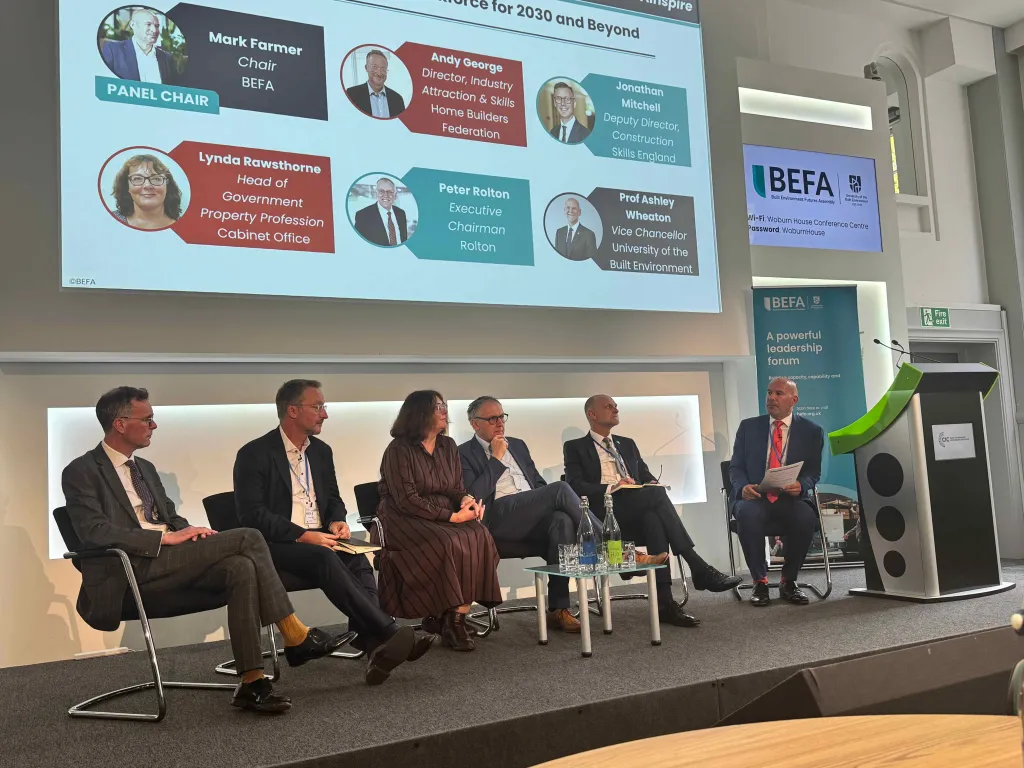
Supported by the Construction Leadership Council (CLC) and Construction Industry Council (CIC), the event included speakers from Oxford Economics, Arcadis and the Department of Business and Trade. There was also a panel discussion involving the Home Builders Federation, Skills England, the Cabinet Office, Rolton and UBE.
Most helpful was Mark’s initial presentation which encouraged a new narrative, separating out “workforce gaps” from “skills / competency gaps”.
He’s right. We often lazily refer to construction’s “skills crisis” and talk about the need to bring in 250,000 new entrants, as if that’s the answer to everything.
But as always in the built environment, the issues are deeper, more complex and more interwoven.
Supported by the Construction Leadership Council (CLC) and Construction Industry Council (CIC), the event included speakers from Oxford Economics, Arcadis and the Department of Business and Trade. There was also a panel discussion involving the Home Builders Federation, Skills England, the Cabinet Office, Rolton and UBE.
Most helpful was Mark’s initial presentation which encouraged a new narrative, separating out “workforce gaps” from “skills / competency gaps”.
He’s right. We often lazily refer to construction’s “skills crisis” and talk about the need to bring in 250,000 new entrants, as if that’s the answer to everything.
But as always in the built environment, the issues are deeper, more complex and more interwoven.
Asking better questions
What I like most about strategic workforce planning is that it forces us to ask better questions:
Do we really know what we’ve already got? The sector is notoriously fragmented, involving casual and itinerant labour, SMEs and micro businesses, multiple levels of sub-contracting and cyclical employment trends which make it really hard to get a clear picture. Tackling the sector’s skills needs is not just about getting more new entrants, it’s also about doing more with what we already have – so we really do need to get a better handle on this data.
Are we incorrectly predicting the future based on the past? For example, what will be the impact of industrialised construction, new product / building system innovations, or new technologies like AI? How do these things recalibrate job roles and future competencies?
Similarly, what will be the impact of current built environment systems-level reforms, such as the digitalisation of planning and building control?
How well have we considered the views of Gen Z and future generations? The indications are strong that they like the sound of construction – contrary to popular belief, we do not have an attraction problem. (If you’re looking for yet more evidence on this, check out the recent Barratt Redrow report ‘Rethinking the Route’, published in February). But how well are we aligning employment opportunities with these attitudes and then retaining these young people?
How much should political priorities shape our forward planning? Mark Farmer explained that pipeline planning is crucial for workforce planning (and as Simon Rawlinson from Arcardis stressed, that means accurate “deliverable pipeline” not aspirational “investment pipeline”). But predicting future demand should not be based on vested interests or political commitments, as there are too many risks – for example, if the UK’s commitment to Net Zero and decarbonisation fundamentally shifts, could we be putting wasted effort into skilling up for major projects that get cancelled?
And how are we really going to tackle the industry’s diversity and inclusion issues? We can’t plan a future workforce where a huge proportion of people are excluded. There was a strong call at the event for a new, reformed conversation about this, and a systems-level challenge on behaviours (the B in SKEB) – including, for example, highlighting the proven economic benefits of increased diversity and looking at the role of procurement in driving culture change.
Fundamentally, strategic workforce planning should tell us how many people are needed in future, where, when, and the actual skills / different levels of competencies they will need.
There are examples from Singapore, Australia, New Zealand and elsewhere we can learn from.
The good news is that this thinking is now happening in the UK.
Do we really know what we’ve already got? The sector is notoriously fragmented, involving casual and itinerant labour, SMEs and micro businesses, multiple levels of sub-contracting and cyclical employment trends which make it really hard to get a clear picture. Tackling the sector’s skills needs is not just about getting more new entrants, it’s also about doing more with what we already have – so we really do need to get a better handle on this data.
Are we incorrectly predicting the future based on the past? For example, what will be the impact of industrialised construction, new product / building system innovations, or new technologies like AI? How do these things recalibrate job roles and future competencies?
Similarly, what will be the impact of current built environment systems-level reforms, such as the digitalisation of planning and building control?
How well have we considered the views of Gen Z and future generations? The indications are strong that they like the sound of construction – contrary to popular belief, we do not have an attraction problem. (If you’re looking for yet more evidence on this, check out the recent Barratt Redrow report ‘Rethinking the Route’, published in February). But how well are we aligning employment opportunities with these attitudes and then retaining these young people?
How much should political priorities shape our forward planning? Mark Farmer explained that pipeline planning is crucial for workforce planning (and as Simon Rawlinson from Arcardis stressed, that means accurate “deliverable pipeline” not aspirational “investment pipeline”). But predicting future demand should not be based on vested interests or political commitments, as there are too many risks – for example, if the UK’s commitment to Net Zero and decarbonisation fundamentally shifts, could we be putting wasted effort into skilling up for major projects that get cancelled?
And how are we really going to tackle the industry’s diversity and inclusion issues? We can’t plan a future workforce where a huge proportion of people are excluded. There was a strong call at the event for a new, reformed conversation about this, and a systems-level challenge on behaviours (the B in SKEB) – including, for example, highlighting the proven economic benefits of increased diversity and looking at the role of procurement in driving culture change.
Fundamentally, strategic workforce planning should tell us how many people are needed in future, where, when, and the actual skills / different levels of competencies they will need.
There are examples from Singapore, Australia, New Zealand and elsewhere we can learn from.
The good news is that this thinking is now happening in the UK.
Lessons for built environment communicators
Finally, I came away from the BEFA event thinking there were at least 6 useful lessons from this discussion for all construction and built environment PR and comms professionals, and for our clients:
1. We should be more precise and thoughtful in our communications:
- Stop peddling the myth that young people are not interested in construction and we have an existential, overarching “image problem”.
- Stop conflating workforce gaps with skills/competency gaps.
- Stop assuming whatever we do on skills-related campaigns must be tied back to “250,000 new entrants”.
2. Know what part of the problem we are tackling. Then build systems change, not just launch another well-meaning initiative. Avoid tokenism.
3. Match our industry recruitment campaigns and upskilling initiatives with actual demand – ensuring sustainable employment and meaningful competencies needed well into the future.
4. Hardwire diversity and inclusion into everything we do. Role models can help, but also think harder about how our work can fundamentally change industry behaviours.
5. As the HBF is demonstrating with its skills initiatives in homebuilding, have the courage to push the boundaries on a small scale to start with. Test, measure and then scale up. (Collaborations are crucial to the last bit).
6. Try and create robust measurement and ways of generating reliable, sustainable data from our work, which can then plug a gap in the UK’s datasets on employment and skills.
1. We should be more precise and thoughtful in our communications:
- Stop peddling the myth that young people are not interested in construction and we have an existential, overarching “image problem”.
- Stop conflating workforce gaps with skills/competency gaps.
- Stop assuming whatever we do on skills-related campaigns must be tied back to “250,000 new entrants”.
2. Know what part of the problem we are tackling. Then build systems change, not just launch another well-meaning initiative. Avoid tokenism.
3. Match our industry recruitment campaigns and upskilling initiatives with actual demand – ensuring sustainable employment and meaningful competencies needed well into the future.
4. Hardwire diversity and inclusion into everything we do. Role models can help, but also think harder about how our work can fundamentally change industry behaviours.
5. As the HBF is demonstrating with its skills initiatives in homebuilding, have the courage to push the boundaries on a small scale to start with. Test, measure and then scale up. (Collaborations are crucial to the last bit).
6. Try and create robust measurement and ways of generating reliable, sustainable data from our work, which can then plug a gap in the UK’s datasets on employment and skills.
Find out more...
If you're interested to hear more, Mark Farmer is talking about these issues to Sean Kearns from CSCS and Suzannah Nichol from BuildUK at UKREiiF this year, on Tuesday 19 May.
We'll be there too, so come and say hello.
We'll be there too, so come and say hello.
By Liz Male
18 Apr 2026